
This 10VC edition is about Ulvi Rashid. He started in Baku, trained in finance at PwC and EY, streamlined deals at VTB Capital, sharpened his edge at Carnegie Mellon, and now backs ambitious enterprise and deep-tech teams in Silicon Valley. Ulvi’s journey proves that disciplined finance plus curiosity can scale into real, global impact
Hello! Who are you, and what do you do?
I’m Ulvi Rashid, a Silicon Valley–based venture capitalist investing across enterprise software and applied deep tech. I back founder-led companies selling real value to large, regulated customers—where traction is measurable and expansion is repeatable. My work sits at the intersection of curiosity, creation, and capital: helping teams turn intent into systems, systems into scale, and scale into enduring companies.
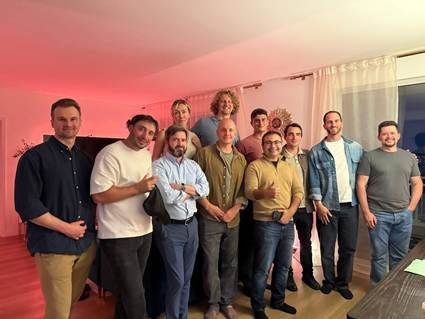
Guest VC on annual founders meeting of Somersault VC in California
What’s your backstory, and how did you get here?
I grew up in Baku (School No. 160), won a Presidential Scholarship in 2004, and studied International Economic Relations at the Azerbaijan State Oil Academy. Early on I loved structured problem-solving—numbers as a lens for how organizations actually work. While at university I ran research projects (SIAR) for Coca-Cola and Unibank, co-founded Magnat (Azerbaijan’s largest student intellectual games club), and competed internationally, which taught me to combine analysis with execution.
My first full-time chapter was PwC—oil & gas investigations across Siberia for global clients like BP and E.ON—where I learned rigor, feedback culture, and the limits of “detective finance.” I then moved to EY to build forward-looking skills: three-statement models, valuation, M&A support, and IPO prep (including Polyus Zoloto’s London listing). At VTB Capital, I streamlined commercial real-estate financing—cutting cycles from years to months—but also saw how big institutions often resist efficiency.
That pushed me toward innovation itself. I moved to the U.S. for an MBA at Carnegie Mellon (Tepper) to immerse in AI/robotics. At CMU’s Tech Transfer Office I worked on commercializing patents and built a visual patent database—my first bridge between research, corporations, and capital. Through that network I entered VC.
Take us through the transition into venture.
Breaking into VC required persistence and serendipity: an analyst role via CMU’s ecosystem, a year of “useless” early-stage models that taught me how investment committees really decide, and then a full-time seat earned through relentless networking (including a Stanford event I wasn’t even supposed to attend). I started in late-stage and pre-IPO—audited numbers, visible traction, real paths to liquidity—then evolved toward growth-stage enterprise software where my operating instincts and executive network create more actionable edge.
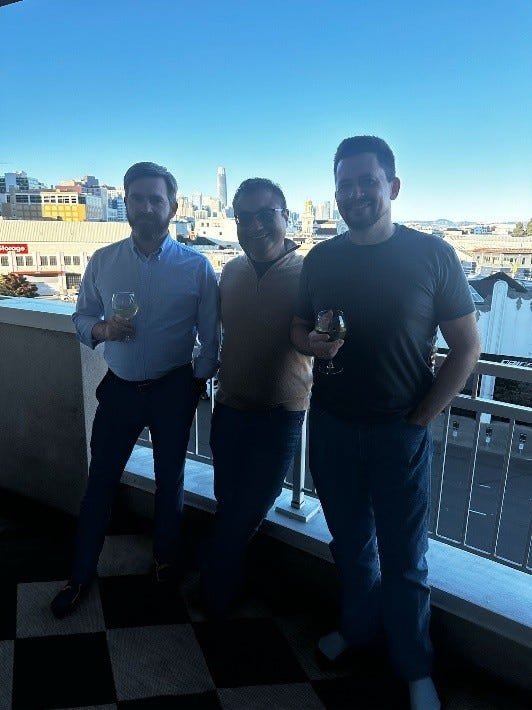
Knowledge sharing with portfolio founders - Alex Babin (Hercules AI) and Konstantin Savenkov (Intento), San Francisco, August 2025
How have you grown and scaled your investing practice so far?
We built a repeatable motion: (1) source with customers—CIOs/COOs/CFOs in our network often bring us problems first; (2) underwrite on outcomes—look for $1M+ ACV proof points and net revenue expansion; (3) stay hands-on post-check—activate executive intros, shape offers, and pressure-test hiring. Across late-stage syndicates we deployed $211M into 21 companies (Deep Tech, FinTech, AgriTech, Enterprise); six IPOs to date; median MOIC ~3.2x; SpaceX the standout (~10x mark). That track record informed our current focus: founder-led B2B software with measurable ROI.
What’s your investment philosophy?
I frame it as three human imperatives —“investment vectors”:
Expand habitats beyond Earth (space economy and enabling tech).
Sustain life on Earth (energy, food systems, climate resilience).
Accelerate progress within existing systems (enterprise AI, fintech, infra, bio-enabled tools).
Every deal must directly advance at least one vector. Tactically, we prioritize enterprise software where adoption, retention, and expansion show up in numbers—and where our network can materially tilt the odds.
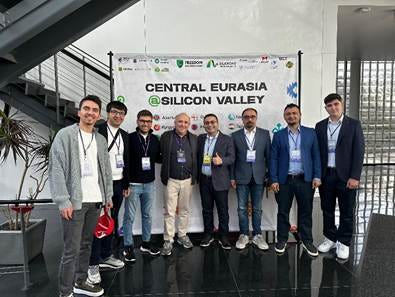
Welcoming Azerbaijani delegation in Silicon Valley for Central Eurasia’s Inaugural Summit in 2024 where I judged the Grand Finale of Unicorn Cup pitch competition
How has your background shaped how you work with founders?
Audit/accounting taught me to see the base layer; investment banking added transaction mechanics; operating roles built empathy for execution. I underwrite people first: consistency of words/actions over time, co-founder alignment, and an ability to scale judgment as fast as the company. Boards and advisors matter only if they engage—prominence without participation is noise.
What were some of the biggest lessons you’ve learned?
• Balance diligence: copying “brand-name” investors is under-diligence; demanding five-year precision from a pivoting seed company is over-diligence.
• Don’t over-help: replace missing capabilities with hires, not investor heroics. Otherwise you create dependency and churn.
• Avoid physical-world trap without readiness: perishable/complex supply chains multiply risks; software iteration and margins compound faster.
• Timing ≠ genius: some misses (Snowflake, Auth0) were translation problems—if you can’t explain infrastructure value to non-technical capital, you won’t capture it.
How has running your own platform changed your lifestyle?
Less specialization, more synthesis. One day is founder psychology; the next is AI security; the third is enterprise sales ops. I anchor on routines (deep work blocks, exercise, family time) and “radical candor with kindness.” Speed matters, but relationships compound only when people can feel you genuinely care.
What are your future plans?
Double down on applied AI for enterprises (clear ROI > “demo magic”), AI security and infra, and the energy/intelligence nexus. In the region, I’m excited by “GMV enablers” digitizing SMEs across fragmented markets. More broadly, I want to be a bridge—aligning founders, corporates, and governments to accelerate responsible adoption across geographies.
Any advice for people moving from corporate roles into VC or startups?
• Build from first principles: talk to customers; validate need before modeling upside.
• Translate, don’t just believe: if you can’t explain the “why now” in simple terms, keep iterating.
• Optimize for upside, not fear: punitive terms kill future rounds and founder motivation.
• Invest in mentors and peers early: the right network is a predictive signal.
• Own your trajectory: agency beats excuses; values prevent the worst mistakes.
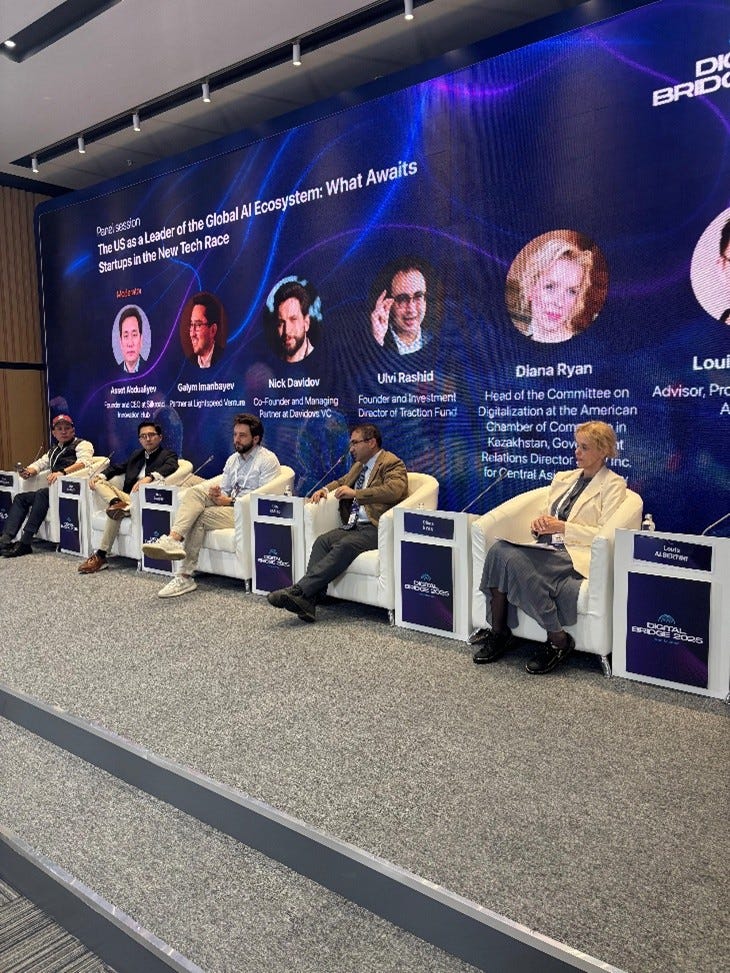
Silicon Valley VCs on Digital Bridge Kazakhstan with topic of US Supremacy in AI race, October 2025
What’s next for the region?
The gap isn’t capability—it’s timing. The U.S. consumer cycle is mature; Central Eurasia is just beginning to digitize its B2B/B2C foundations. Valuations are lower, industries fragmented, data more accessible—fertile ground for SME platforms and cross-border builders who pair local know-how with global markets. The bridge model—teams split across Chicago–Almaty or SF–Baku—will produce the standouts.
Parting thoughts
Success is preparedness meeting opportunity—luck that repeats because you built the muscles. AI will amplify good investors, not replace them. And legacy is purpose made practical: methods for mastering yourself, and institutions that move humanity forward. Ulvi’s bet is simple: align great people, clear vectors, and compounding systems—and the future becomes inevitable.
Quick Fire Round
Biggest misconception about venture capital?
That if you have a friend who’s a VC, they have to invest in you — or that VCs lack deal flow. The best founders to invest in are the ones who don’t need money and will figure it out themselves — often the oversubscribed ones. No VC wants to be the savior or the last investor in the round.
A founder who impressed you most — and why?
I’ve seen many great founders, but recently the Rakhmetzhanov family stands out — Sanzhar, Temirlan, and Arlan. A whole family of entrepreneurs charging each other forward and accelerating mutual progress across multiple companies.
One book every investor should read?
From Zero to One by Peter Thiel.
Worst advice you’ve ever received?
Can’t recall — maybe that’s for the best.
What motivates you today — money, mastery, or meaning?
Meaning is the ultimate fulfillment mechanism. Money is the resource that enables meaning. And mastery is the path that grants access to both — and lets you go the distance.
Quick Facts & Figures
• Name: Ulvi Rashid
• Base: San Francisco Bay Area (global mandate: U.S. & Central Eurasia)
• Background: PwC (forensics, O&G), EY (valuation/M&A/IPO), VTB Capital (structured finance), Carnegie Mellon (MBA; Tech Transfer)
• Stage Focus: Growth-stage enterprise software; selective late-stage/pre-IPO and applied deep tech
• Thesis Pillars: Space & frontier; sustainability; enterprise acceleration (AI, cyber, infra, fintech)
• Sourcing Edge: Executive/LP network (“market as IC”) and customer-led referrals
• Representative Wins: SpaceX (~10x mark); multiple portfolio IPOs; median MOIC ~3.2x across 21 late-stage deals
• Operating Style: Hands-on post-investment (enterprise intros, offer shaping, exec hiring support)
• Guiding Principle: “Be a small part of a big story, not a big part of a small one.”
Ulvi’s LinkedIn: https://www.linkedin.com/in/ulvirashid/